Episode Transcript
[00:00:00] Speaker A: Foreign.
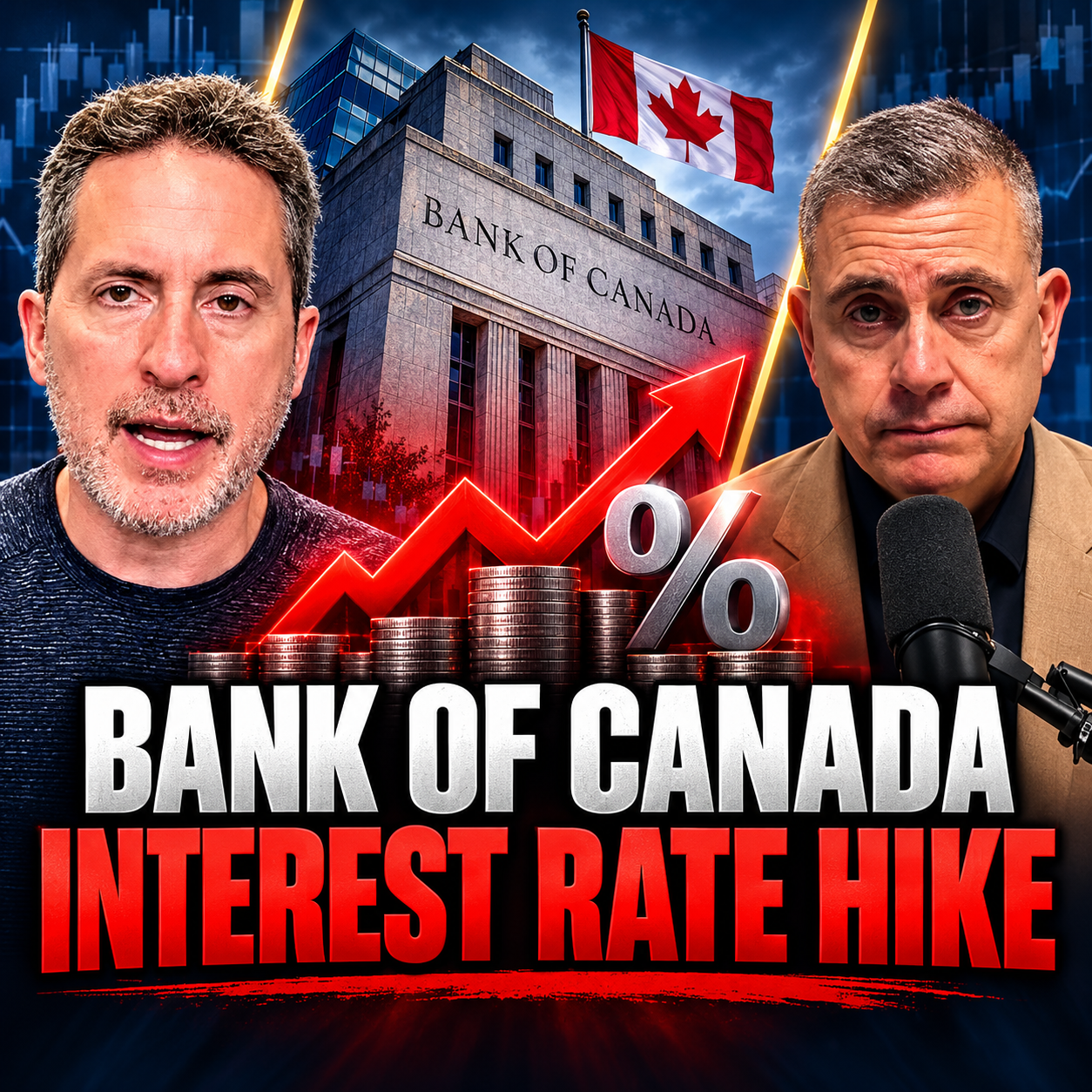
So interest rates went up a quarter percent today, and I'm lucky enough to have Moshe Lander with me. Hi, how are you doing today? I'm well, thanks. Good, good. So not unexpected. We had heard for a few days that interest rates were going to go up and potentially I guess they could go up even more. We heard today after Tiff Macklin kind of gave his speech from the bank of Canada.
Your thoughts?
[00:00:32] Speaker B: I'm disappointed. Normally, I'm in full agreement with the bank of Canada. I'm one of their biggest supporters and advocates. I don't get this one. I was part of the 20 to 25% that was thinking that interest rates were going to stay where they were. I know a lot of mainstream economists as well were kind of raising their eyebrows at the thought that it was going to go up. Now that it has, and even now that I've heard Tiff Macklem speak, I'm not sure that I'm entirely convinced that this was the correct decision.
[00:01:00] Speaker A: Yeah, I agree with you. I'm not comfortable with the decision at this point. I thought it didn't pay attention to a lot of other factors, to tell you the truth. And a stagnating economy, basically a slow real estate market, housing being in disarray, manufacturing activity being slow.
Honestly, I didn't understand why he would want to make this move. And it seemed like it was solely on gas prices, on oil.
[00:01:29] Speaker B: Yeah.
And, you know, if you look at what's causing inflation to run a little hot in consumer markets, it's Russia, Ukraine, it's the Strait of Hormuz, it's tariffs and trade disruption. All of those are supply side issues, not demand side issues. So where the bank of Canada is at its most effective is when it addresses a demand side issue. Let's say the consumers get a little overconfident, businesses get a little too full of themselves, and they go on these spending binges. That's the type of thing would lead to inflation. So with one move of the interest rates, you take some of that consumer confidence away, you take some of that spending away, and you remove some of that inflationary pressure works very nice and cleanly in addressing all things at once. But when you have this supply shock that's happening, whether it's the disruption through Russia and Ukraine, whether through it's the closure of the Strait of Hormuz, or whether it's just the uncertainty for businesses trying to negotiate trade and the current state of North American markets, the problem is that when you do increase interest rates, you push the economy further into stagnation. So you might solve the inflation problem, but you don't solve the stagnation problem. If the bank of Canada had sat on its hands, I guess their fear was that, fine, it might help the economy have a little more space to grow in some of those sectors that you outlined, but it might let inflation run a little bit hotter. I think that the solution here, though, is probably outside of Canada's control, and it's 10 days away. It's those midterm elections in the U.S.
if the Democrats take control of the House, if they take control of the Senate, I can promise you that come January, they're going to wrestle control of the trade negotiations with Canada. A lot of those tariffs will come down. There will be an agreement. Maybe not as good as the original NAFTA agreement, but there will be an agreement. And so that removes one of the big bottlenecks. And, of course, the Democrats are going to be much more pro Ukraine, much more anti Russia. And the fact is, Russia was being starved of funds. They were probably going to run out of momentum to keep up the fight, and they would have had to sit down and negotiate. And, of course, maybe the Iranian regime might, now that Trump's worst excesses aren't going to be encouraged but discouraged. Maybe there's room to negotiate an opening of the Strait of Hormuz and get energy supplies back online.
[00:03:36] Speaker A: Yeah, no, no, I totally agree.
You think a strategic mistake, and I get that the bank of Canada and the Prime Minister, the government, are two different entities, but you have to think that you're sitting in Prime Minister Carney's seat right now, and you're thinking, you know, was that a great announcement for me today, given the fact that I might be close to negotiations that I might be doing? And I have the midterms coming up, and I thought the same thing. I thought, how bad of. You know, and I just a delay for one more rate announcement strategically made so much more sense. And you think, quite frankly, that coordination would have gone on that conversation because.
And I was hoping that you could shed some light on this, because I was reading the last couple of days, I'm reading how they make their decision whether to hike the rates or not rate the.
Or to lower them. And they basically, from what I understand is they do a central bank survey of consumer expectations. So they go out and they survey 2,000 households if I'm close, and they basically get it back, they sit down, they look at it, they dissect the information, and then I guess they look at all the different indicators across the economy.
And is that kind of the thumbnail they use to make that decision?
[00:05:00] Speaker B: Yeah, it's certainly the high level approach. Right. So the bigger issue is not the inflation rate itself, it's the expectation of the inflation rate. So inflation will go up and down all the time. And it's really not the bank of Canada's responsibility to micromanage it to keep it at exactly 2.0 at all times. So they'll let it move within that 1 to 3% range. What they want to see, though, is what do consumers think it's going to be? And if consumers say that we believe it's going to be between 1 and 3, then even if it falls below the lower bound, and even if it goes above the lower bound, the bank of Canada probably puts their hands in their pockets and says, we're okay with that. Because at least consumers understand that this is a temporary phenomenon. The issue becomes, what if consumers start to think that it's not going to stay between one and three? Or what if consumers have a trend where it's showing that they used to think it's 2, now it's 2.5, then it's 2.9, then it's 3.3. The bank of Canada says maybe we need to send a signal to consumers that the bank of Canada is committed to keeping inflation between 1 and 3%. And yes, you're right. When they do that survey, maybe Canadians are starting to lose confidence that inflation will be kept in that target range. And so here's the signal then. Unfortunately, that wasn't quite what we heard today from the bank of Canada. It almost seemed to me as an Albertan that it sounded like they were saying that the oil and gas sector is doing particularly well. So here's an interest rate hike, especially where you're talking about the Prime Minister. I thought the direction you were going to go is we just came out of an extremely damaging, foolish referendum in the province where the Prime Minister was trying to show that Alberta matters. And here comes the bank of Canada swinging and saying Alberta's doing well. So here's an interest rate hike. Beyond the fact that it seems to be punishing Alberta, it's not going to endear Alberta to the rest of Canada. They're going to say our sectors are not doing well. Why are you hitting us with an interest rate hike?
And of course, the other part of it as well is that Mark Carney, among all people, is a former governor of the central bank himself. And while he has no control over policy nor should he? You're right. There are these backdoor channels where the bank of Canada, at a minimum, will at least have a conversation with the finance Minister saying, this is what to expect.
Here's a little heads up. And fine, that heads up might only be 15 minutes, it might be a full day. But the idea here at least is expect that this is coming so that you can get in front of the mics as well and not express stun reactions to what happened.
[00:07:20] Speaker A: Yeah, no, I agree. So the interest rates goes up. The dollar today starts to go up.
So the dollar,
[00:07:29] Speaker B: it could.
It's interesting because I don't know that the dollar necessarily goes up because of the interest rate increase today.
I think that the dollar started rising in the last couple of days. And so this is one of those basic ideas of finance. It's called the efficient markets hypothesis. So based on all publicly available information, markets should be incorporating that into the prices of shares and bonds and things like that. And if you look, the bank of Canada gave a signal a few days ago at some meeting halfway around the world that there might be an interest rate increase coming. And so markets probably would have seen that. And that's why betting markets had it at a 75 to 80% chance that today was going to be the interest rate.
So probably a couple of days ago they started buying up the Canadian dollar in anticipation. Today, when the announcement comes, markets might shrug and say, we already price that in. But as a broader picture, yes, when the bank of Canada increases interest rates, whether it started happening a few days ago or right now, the Canadian dollar will appreciate in value.
[00:08:29] Speaker A: Right. So then if you're exporting things, it's not as good for you if you're importing, or, sorry, if you're importing, it becomes more expensive.
Right.
[00:08:38] Speaker B: A stronger Canadian dollar, no, that's bad
[00:08:41] Speaker A: exports and
[00:08:42] Speaker B: it's good for imports.
[00:08:42] Speaker A: Yeah,
[00:08:43] Speaker B: but
[00:08:43] Speaker A: if you
[00:08:43] Speaker B: think about it, that weak Canadian dollar prior to this announcement or prior to the signaling of the announcement, that was good for exports, and a lot of Canadians appreciate then that a weaker Canadian dollar does have some value. But think about what that means domestically for inflation. If the Canadian dollar is weak, which means it's good for exports, one way to think of it is that there's a whole bunch of foreigners that are in line with us Canadians to buy Canadian goods and services.
So if this extra source of demand coming from foreigners, great, good for exports. But it also means that there's this inflationary pressure that exists as well, because there's now all these customers that want to buy our stuff, too. But the other channel in which there's inflationary pressure is that what we're buying from the US Is now more expensive in Canadian dollar terms than it would have been if the dollar had been stronger. So here, too, is another source of inflation. So even with all of that weak Canadian dollar stuff, if only 3.1% inflation surfaced, I don't know that there was really that compelling argument. If the Canadian dollar gets stronger, it does remove some of the inflation through the export channel because foreigners will walk away from Canada.
And it will remove some of the inflation through the import channel, because now buying an iPhone is going to be less expensive in Canadian dollar terms than it otherwise would have been.
[00:09:58] Speaker A: Right, okay. But you're sitting to your point about Alberta and trade and the rest of Canada, you're now sitting with higher interest rates, quite frankly, on whether it be lines of credit, mortgages, bank loans, car loans, whatever you're actually doing.
Traditionally, banks don't hike their interest rates much as far as what they pay you.
So your cost of living is higher, and quite frankly, you're exporting things less frequently. So how is it?
I just couldn't. I just. I guess I'm looking at it and I'm thinking. And on top of it, on top of it, you're now at the pump. So you're now. Your interest rate's higher.
And the rationale is your interest rate is higher now because your gas prices are higher.
[00:10:50] Speaker B: Yeah. So it's a bit of an odd one to try and scratch your head through.
I agree with you. Higher interest rates then are going to raise all the borrowing costs, and Canadians are massively indebted. So this is going to take more and more of your disposable income that you're now going to have to allocate towards just paying the interest on your debt, forget about actually retiring the debt. That means there's less money to buy actual physical goods and services. So this is bad news across the board then, for the consumer sector, that makes up about 60 to 65% of the economy. But it's bad news for businesses, too. Right. So for anybody who's looking and saying, well, the energy sector is strong, the energy sector right now is making some complicated decisions about whether they actually want to invest in more pipelines, expanding the oil and gas sector and a lot of the infrastructure that the Prime Minister wants to try and orient Canada east to west rather than north to south. But if you look at the bottom line, then if interest rates go up, if your borrowing Costs go up, these profitable projects become less so, or they even become unprofitable projects. And so what any reasonable business would do then that's pursuing profit is going to say, I'm delaying the project, I'm canceling the project, or I'm even going to move the project to a different location if I can. Where this isn't going to be a concern for me then. So that harms business investment, capital formation, long term potential for the economy. And of course, if businesses scale back, there is the risk that they start firing people because we don't need you anymore, because we're not taking these projects on anymore. So there's that risk factor there too. You mentioned that the foreigners disappear, fine. So there's another source of demand disappearing. We start buying more foreign goods. That doesn't show up in Canadian gdp. And of course the other play card here is the government's now going to have more expenses as well. Governments have huge amounts of debt at the federal and provincial level. Their cost of borrowing just went up as well. So now when they refinance their debt and roll it over, they're going to have to pay higher interest rates than they would have 48 hours ago.
Where are they going to come up with that money? They got to go to their taxpayers and say, sorry, kiddos, taxes either need to go up or spending needs to go down. In either of those cases, that's another hit to consumers and businesses that are now going to have to fend more for themselves than they otherwise would have.
[00:13:04] Speaker A: Yeah, we just did a show with the pbo, the federal pbo. It was very interesting. And in her report, in her October report, she talks about the fact that corporate tax has actually almost doubled since 2021.
So again, you have these corporate taxes almost to $100 billion from like 50 billion. It's crazy how that number has gone up so much and it's such a bigger part of the revenues of the government. And then at the same time now they jack up the interest rate to hurt corporations and themselves because they're, you know, in that report she talks about, Quite frankly by 2030, the interest going up to about $83 billion a year. So it's just skyrocketing the interest cost.
The interest charges on our statements for the government,
[00:14:00] Speaker B: yeah, it's a staggering amount. And for everybody who says, well, this is 10 years of liberal rule, yes, but it's 30 years of liberal and conservative rule that have been pushing this trend. So it's not just the recent liberal government and it's ironic too, because, you know, if you're old enough, I'm old enough to remember. I would call Mark Carney one of those blue Liberals. You know, he's certainly got that pro business streak in him that, you know, we saw Jean Chretien we saw on Paul Martin, but generally is not very strong within the Liberal party and that's usually what makes them electable nationally is when they kind of drift to the center and they adopt some of that conservative thinking, they usually find a path to government.
The problem with increasing corporate income taxes so much over the last five years, whether through legislation or otherwise, is that that chokes off investment.
And any economist will tell you that in order to have long term growth, long term standard of living increases, you need capital formation. Whether that's capital formation in your head, human capital, physical capital with machinery, equipment, factories and stuff like that, or technological advancement as well. Those things only come about when firms feel the need to innovate, when they sense that there's a profit opportunity and if it's all going to be taxed away, then that's the type of thing that could actually not just harm the economy in the short run, but in the long run as well. I'm surprised that a centrist liberal would be taking such ideas as orthodoxy here and not trying to push back a little bit. But I think that the Canadian public these days just want to go after the rich and indiscriminately. I don't care who that means as long as it's not me. Just go get money out of them. And right now that anti corporate sentiment might be political, popular politically, but it's really bad economics.
[00:15:48] Speaker A: Well, you and I have talked mostly about the productivity and the lack of productivity in Canada right now and the challenge we're having as a nation to get that productivity per capita number up.
But I find it interesting because in the last budget they spent well. They, they included a lot of economic development tax breaks. They, they did a lot of things. And even recently in some of the capital projects that they put on the table, they've actually allowed different tax breaks to get to incentivize people to actually do those developments. So in this case now, you know, if we hit another interest rate increased by the end of the year, we're going against our tax incentives. Disincentive again.
It looks a little bit like, and I know the two are two different arms, but it looks like kind of the Finance Minister and the bank of Canada and Tiff Macklin need to sit down and have a long Conversation about strategy here, it looks disjointed, truthfully. It looks, it looks like almost one hand's not talking to the other hand.
[00:16:57] Speaker B: Yeah, you're right to some extent. You know, there's these two different ideas. There's policy coordination, there's policy conflict.
So I agree that policy works best when it's coordinated. And that's not any sort of nefarious cigar smoking, brandy sipping, backroom dealing that's going on here. It's just merely a matter of communicate what it is that you're seeing. And for sure, with the bank of Canada, you know, one of their rules is that they act as the advisor and agent to the government. The agent bit is merely if the government runs a deficit and they say we need to come up with this money, they go to the bank of Canada and say, find it. The bank of Canada of course, can go the nuclear route where they print the money. But much likelier is that the bank of Canada is going to be the ones that's issuing the bonds to the public, collecting the money to finance that. Nothing wrong there. But the agency bit is interesting as well then.
Or the advisor bit is interesting where the government should say, look, this is what we're thinking of doing. The bank of Canada could say, look, this is what it'll mean for inflation or what we think it'll mean for unemployment. Similar to the parliamentary budget office. Here's our analysis. You're free to do whatever you want. You are the elected people. You have your representatives that you have to answer to.
We are not elected, nor should we be elected. And so we can offer you impartial advice, do with it as you please. And that coordination then would maybe lead to, hey, if you're looking to try and offer these breaks here, we might be willing to tolerate a little bit of inflation a little longer than we otherwise would. Remember though that at the end of the day, the mandate of the bank of Canada is to keep inflation between 1 and 3%. So there is a certain heartlessness that has to come with monetary policy in Tiff Macklem's office, where I get it, it's not good for the economy. But that's not what's on my table as my responsibility.
[00:18:40] Speaker A: How do the banks react? So I was just, as you were saying that I'm thinking to myself, if I'm sitting in, you know this, our banks, quite frankly, is there any, you know, they're, of course they, they lose business, they have default challenges, you know, what are they coming out of this?
[00:19:01] Speaker B: I think within the 20 to 25% that were not anticipating this hike. I said I was one of them. I think a lot of the heads of the big banks were in that camp too, that they were saying, I don't think that you need do this, or at least you don't need to do it. Now of course they're going to increase their borrowing rates across the board. And so at least it's a very, very short term phenomenon. This should mean extra profits. I'm not saying race out and buy shares of BMO or CIBC or anything like that. By the time this makes it to air, that will have already been incorporated into those share prices. But you know, one thing to consider, you're right, is will this lead to higher default rates going forward? As more and more Canadians say, I was barely able to make ends meet with the debt load that I had at the interest rates that were there as of Wednesday morning. I can no longer do this at these new interest rates. But you know, the thing is with the banks, I always say this to people when they ask about this. The banks aren't interested in your home, they're not interested in your business, they're not interested in your car. That's not the business they're in. The business they're in is lending you money and they want the money back. So if you're transparent with your bank, they will probably do anything and everything they can to restructure your loan to ensure that they get their money back. Not that you have to fire sale your home and then they have to try and drag you through the court system to get their money. So, you know, I think that there's an opportunity here that if Canadians at least have enough confidence to go to their bank and say, look, this is the situation I'm in. If you have enough equity, if you have enough years of amortization that you can renegotiate, if you have a stable enough income, banks would probably be willing to renegotiate your mortgage. They might even be willing to waive some of the fees if they know that, hey, at least this isn't going to lead to some run on bankruptcies, whether those are personal or business bankruptcies because it's just an area that they don't want to get involved in. And they also don't want to have to necessarily scale back their lending because they've been once burned, twice shy.
[00:20:52] Speaker A: Right, right. No, it's interesting.
So at the end of the day we wait now for the next announcement.
And so you were just saying you didn't think this one was happening. So crystal ball with me for a minute. It won't hold you. I'm just saying. Do you think he goes again before the year?
Well, my
[00:21:11] Speaker B: credibility is shot. When I said that I didn't even think that he should be doing this. So
[00:21:15] Speaker A: I
[00:21:15] Speaker B: don't know what my prediction is worth. Look, I would have argued that if things are not moving in the right direction after those midterm elections, then go ahead, increase interest rates in December. So I think the fact that we got it now in October should give a little bit of leeway then, that we shouldn't really be talking about an interest rate increase in December. I think there's enough stuff that's going to change in the next month or so that some of that inflationary pressure should come out. I think the real thing to watch, though, is that we're going to get an inflation number in November and that's going to be the one that you want to circle on your calendar. Because if that thing comes in above 3.1 substantially so, if consumer sentiment is moving towards that 3% upper limit or outside of it, then yeah, there's probably a good chance that another one's coming. But if the numbers come in that they're at least reasonable within the bank of Canada's range, and certainly if you strip out energy and food and see that that core inflation is kind of hanging around 2%, then I think we saw the worst of it. And that might open the path then for 2027 to allow for a little bit of recovery, a little bit of space for the economy to grow. And if there's a trade agreement, if the tariffs come down or go away entirely, and if energy starts flowing, then I don't know that the bank of Canada is necessarily going to undo it in December, but we could easily be talking about that this was it. And in 2027 we might even be able to see that quarter percent come back.
[00:22:31] Speaker A: Well, that'd be good news. It does feel like the economy is kind of the sacrificial lamb in this senseless and I figure senseless fight to reduce inflation.
And we've sacrificed kind of the state of our domestic because domestic demand hasn't had any real input on it. Right. Other than what's going on. And I feel that now in this announcement. So I hope that does happen.
[00:22:58] Speaker B: Yeah, look, I'm a big believer in keeping inflation low and under control and stable. I just think that there's probably a little bit of space here where we could have given some room for the economy to grow or at a minimum, we could have seen if that major event in the US Is going to change anything on the ground.
So because the election should be clear by the time we get to the beginning of December when the bank of Canada meets again, fine. The new Congress won't be sitting, but we know who's going to be chairs of the various committees. We know who's going to be speaker of the House. We know what the Senate is going to look like because if that flips to the Democrats, then we know exactly who's going to be running the thing up there, too. And we can start to now start parsing what their legislation is going to look like and what they're going to want to try and introduce or repeal or what Trump's going to even do in response.
You know, why make a decision before that, especially when that decision is 10 days away? It's not like I'm asking for hold off for a year and let's see what happens. It's let's hold off for six weeks when one week from now we're going to know what that decision is. And I'll tell you that the bank of Canada does not want to get into the business of some yo yo interest rate where they increase it in October and decrease into December. That becomes a source of uncertainty as well.
And they shouldn't be contributing to that. So if this thing's gone up, I don't know that it's coming down anytime soon. So it's really going to take something then to make them say, okay, we can undo this.
[00:24:18] Speaker A: Right? That's a great point. Well, we'll wait and see and hopefully, you know, we're not going up again. But I look forward to chatting you through when he makes the decision again.
[00:24:29] Speaker B: Anytime.